Showing posts with label Church Planting. Show all posts

Tuesday, April 15, 2014

Do Church Planting Movements Hinder Disciple Making Movements?

Do Church Planting Movements Hinder Disciple Making Movements? by Miguel Labrador

38_people_climbing_berlin_wallDo CPM’s (Church Planting Movements) help or hinder DMM’s (Disciple Making Movements)?
Jesus said, “Go therefore and make disciples of all the nations, baptizing them in the name of the Father and the Son and the Holy Spirit, teaching them to observe all that I commanded you; and lo, I am with you always, even to the end of the age.” Matthew 28:19,20
I think, for the most part, that those who have a desire to plant churches and those that have a desire to make disciples, have equal convictions to see the message of the Kingdom spread, to see the nations (ethnic groups) transformed, and see many come to know Christ. But, what if one of them were to inadvertently get in the way of the other or even hinder the other?
The Apostles or first disciples of Jesus did not start with what is typically known today as a “church plant.”  They started by becoming mobile, moving, and mission.  They planted themselves and the Gospel into communities until the Lord directed otherwise and made disciples from which gatherings were formed.  The task remained the same throughout the New Testament era, namely to “make disciples.”  In fact, I fail to see anywhere in the New Testament where they had a desire to multiply churches in the sense of location based purveyors of religious goods and services.
If one of these two camps had a propensity to get in the other’s way, I believe it would have to be the church planters.  I am not a church planter, at least not in the way many church planters describe their task.  I like to think of myself as a disciple maker that leaves the method of gathering or fellowship up to the disciples being made.  If that equates to a building, weekly meeting, and bit more structure, then great!  If it means a simpler or more organic approach to fellowship, then again, great.  But when the gathering of disciples takes priority over the making of disciples, then something has gone very wrong.
What I have seen time and again, is that church planters, or at least the idea of church planting, has gotten in the way of disciple makers.  They misdirect resources, time, talent, and energy away from the main mission of disciple making and funnel it into things which are secondary or completely unrelated to that task.  They say that they investment into the facility and structure may draw away from the primary mission for a short time, but afterwards the impact will be greater.  I can’t recall ever having seen that actually happen.  In fact, one of the most successful church plants in history, Bill Hybels’ Willow Creek, confessed that all of their organization, power, influence, programs, teaching and structure, failed to produce disciples.
As a disciple maker, I’d like to proclaim the kingdom of God and teach others about the Lord Jesus Christ–with all boldness and without hindrance! (Acts 28:31)  I want to do that and teach others to do the same.  If you’re a church planter, who’s hindering disciple making, isn’t it time to say “pardon me,” make some room, and let the disciple makers pass?
Eugene H. Peterson (Author of The Message Bible) once said,
“There are monuments & footprints. A monument only says, `At least I got this far,’ while a footprint says, `This is where I was when I moved again.’”
My friend Mike Breen, (Author of “Building a Discipling Culture,” said;
“I’ve said it many times: If you make disciples, you will always get the church. But if you try to build the church, you will rarely get disciples.” 

I think Church Planting Movements hinder Disciple Making Movements.
 Am I wrong?  

Wednesday, March 20, 2013

ARE WE ON THE BRINK OF A NEW REFORMATION? Part I


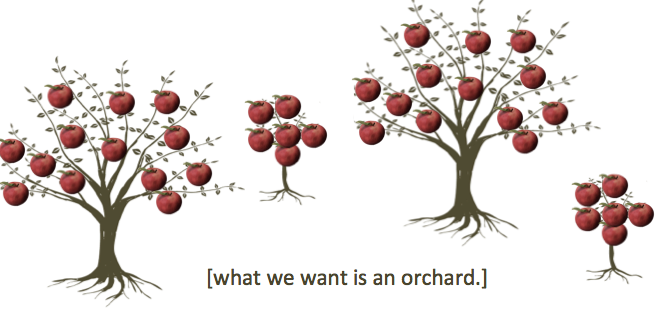
If you could have a big tree with only a little fruit or a small tree with lots of fruit, which would you choose? It’s about a choice, right?
But we’ll get back to that in a second.
I’ve noticed there seem to be two things I can do with Jesus. Either I can increasingly look like Jesus, or I can make him look like me.
I can look like Jesus or I can try to make him look like me.
The funny thing about Jesus is that I’m never sure we give him quite enough credit. Sure. He came to earth, left the throne of heaven, took on the nature of a servant and died on the cross in our place, rose from the dead and now sits at the right hand of the Father. Yes. All that happened.
But we really don’t give his three years of ministry much reference.
Here’s what I mean: We think Jesus was the Son of God, but when we read the Gospels, do you think he was the smartest person who ever lived? Most accomplished? Best fisherman? Best evangelist? Best church planter? Best movement leader? Best discipler? Most successful leader?
For instance, in Luke 9 and again in Luke 10, Jesus gave the most detailed strategy you will ever find in the scriptures for how to evangelize, and then we see the exact same strategy used in the early church. Shouldn’t we be using that same strategy? I’m guessing we’re not arrogant enough to think we’ve come up with a better strategy than Jesus. (Example: for most churches, the evangelism strategy is “invite your friends to church and then let the professionals take over. We’ll do the heavy lifting if you get them here.” Not exactly Jesus’ strategy!)
We acknowledge what Jesus did on the cross, but what about what was started before the cross? What about the movement he began that changed the course of human history when it was released and catalyzed after the Resurrection and Pentecost? If being a disciple is “who Jesus would be if he were me” (Dallas Willard), shouldn’t we be learning the patterns and practices of the best whom ever lived if we too want to change the world for the Kingdom?
Yet often when we look at the Western church, I’m not sure we see many of the practices of Jesus among the way we lead. Though…that’s starting to change!
Back to the original question: Big tree/little fruit or little tree/lots of fruit?
It feels that at some point, we might have lost our way. Perhaps we became more concerned with success than fruitfulness. Jesus says we evaluate things in the Kingdom on their fruitfulness…but somewhere along the way it became about the size of your tree. Now having a big tree is a fine thing. Just know you’re only successful in evaluating yourself against the size of other trees, and God has never been terribly concerned about tree size. Just fruitfulness. That’s it. The point of a tree isn’t how big your tree is but how much fruit you have. It’s about fruit! And in the Kingdom, fruitfulness is always about reproduction. (Specifically, reproducing disciples…multiplying Jesus’ life into the life of others who can then go and do the same.) Screen Shot 2013-03-03 at 8.53.46 AM
My experience tells me having a big tree doesn’t mean you have a lot of fruit. In fact, what I’ve seen happen a lot more often is people going after the big tree and hoping to get fruit, rather than going after fruit and knowing you get the tree along the way.
Choose the best, and you always get the good. Choose the good, you very rarely get the best.
Are we trying to start or lead churches, create Kingdom movements and aspire to all the breakthrough Jesus saw apart from the way Jesus did those things? Am I trying to make Jesus like me or do I honestly believe he was the best in the Kingdom business?
The Reformation was a significant moment because among other things, it put the Bible back in the hands of the people. But when we look at the church of the last 100 years, I have to wonder if we have been more influenced by the Enlightenment than the Reformation.
This is the gut check question: If you had to choose between being known as a movement leader but not really having one, or actually being a movement leader but no one knowing it…which would you choose?
Tree or fruit?
Here’s the good news: I believe we are on the cusp of a new Reformation, one that sees the kind of fruit we saw from Jesus’ ministry, because we, once again, embrace not simply what Jesus did on the cross but the way he led and made disciples. Yes. I think we are on the tipping point of a new Reformation and it is about putting discipleship and mission back into the hands of ordinary people. Because when we equip the people of Jesus with the patterns, practices and way of Jesus, it will once again be ordinary people equipped to do extraordinary things.
The key is to embrace the mission of Jesus AND the way of Jesus. He’s just the best there ever was!
Hopefully you hear what I’m trying to convey clearly. I’m not suggesting we should go after a new Reformation. I’m suggesting it’s already happening. And maybe we don’t see it on every street corner yet, but I see it happening all around. A small group of communities, ready to be bloodied in going through the wall first, who are getting the beachhead of breakthrough for the rest of the church.
It’s already happening!
Screen Shot 2013-03-03 at 8.54.14 AMAt the end of the day, I don’t want a big tree. But I don’t want a small tree either. I want an orchard. I want a Kingdom movement where reproduction of Jesus’ life within individuals and communities is happening on every level. I’ve seen this happen before. I know it because I’ve seen it. And I think we are starting to see glimmers of this reality again. Lord, may it be so! May we see a Kingdom movement wash upon these shores.

If these longings resonate with you, here are three things you can do to step more fully into this groundswell:
  1. breen_bookSlideREPOST. Repost this link on twitter, facebook or your blog.
  2. RESPOND. Leave a comment on this post. Here’s the question: Where are the places you are seeing breakthrough in putting discipleship and mission back into the hands of ordinary people? We’d love to hear about it!
  3. READ. We just released a new book on this subject called Leading Kingdom Movements: the “Everyman” notebook on how to change the world. You can pick up the ebook by clicking here. We think you’ll love it. Write a review. Read it and pass it on to a friend. The thing we are most concerned about is getting this idea out!

ARE WE ON THE BRINK OF A NEW REFORMATION? Part II


ARE WE ON THE BRINK OF A NEW REFORMATION? – MIKE BREEN


Last week I put up a post that discussed whether we are on the brink of a new Reformation. You can read that first post in its’ entirety here.
In summation, I believe that we are heading to that place in as much as the first Reformation had the wonderful effect of putting the Bible back into the hands of the people, the one we seem to be moving towards now is putting discipleship and mission back into the hands of ordinary people.
My suggestion was that when we focus more on the fruit that is produced (multiplying disciples who can do the same), the Kingdom always advances. If you’ve got a big tree (the church)…great…but it doesn’t matter too much if it’s not producing fruit.
Today, I want to look more at that idea of fruitfulness and why we should put all ofour time, attention and energy into it. I think today’s discussion will give us an even deeper look as to why we are on the precipice of something.
To do so, here is an excerpt from my book Leading Kingdom Movements.
++++++++++++++++++
Jesus gave us a picture of a tree and said that good trees are supposed to bear good fruit. It’s a simple picture, really. One tree can give you quite a lot of fruit. But it’s more. In each piece of fruit is the seed of multiplication. Each piece of fruit has dozens of seeds that could produce more trees. And there wasn’t just one piece of fruit on each tree, but lots of fruit.
So let’s run this out:
  • One tree
  • One tree, hypothetically, has 100 pieces of fruit
  • Each piece of fruit has, hypothetically, 20 seeds in it that can multiply into 20 more trees
  • One tree = 2,000 potential trees
Multiplication is what Jesus is talking about in the Parable of the Sower. In another, you expect a return of 30, 60, 100 times what you invest with the one seed. It’s multiplication.
Let’s understand the context of what Jesus was going after. When Jesus talked about trees and fruit, he was referring to something very specific: people. He was saying that each person is a tree, and a disciple is someone who produces good fruit. If we take Jesus’ metaphor seriously, he seems to be suggesting that a disciple will produce thousands of disciples.
If you’re at all like me, that can seem incredibly daunting.
Then you realize where we started and do the simple math. You can’t get there by addition, but you can by multiplication. We take what we’ve been given, invest it, and let it multiply.
Multiplication has been the way of the church for thousands of years because it was the way of Jesus.
The early church had two things going for it:
  1. They had the Holy Spirit.
  2. They knew how to multiply missional leaders.
That was it. No budgets, buildings, or any real cash on hand. All around there was moral relativism, polytheism, hedonism run amok, persecution, and an Empire that seemed to hate the church with a growing intensity.
And they blew the roof off!
At the end of the day, you could launch a missional movement with those same two things—the Holy Spirit and a way to multiply missional leaders. The problem is that many of us don’t actually believe that.
If you were to go to Sheffield (which is now the epicenter of a worldwide missional and discipling movement), they would not tell you how many people attend the church. I doubt most of the people would even realize how big the church is, because it doesn’t function like a huge one.
If you asked how big the church is, they would simply tell you how many people they are discipling. That is what they count. They count how many people are engaged in active, accountable, discipling relationships. Their whole structure for church is built around making disciples and releasing them. So that’s what they count. That’s the metric that matters. That’s the Great Commission imperative.
How many disciples do we have?
St. Thomas Sheffield isn’t a massive church and the center of a movement because it has the best worship service, or the best digital experience, or the best preachers or teachers in the world. It’s because everything they do is about making disciples. They honestly believe that if you make disciples and release them to lead into their destiny, release them to be Agents of the Kingdom, everything will change.
If we are great at making the disciples, church growth will never be a problem, because being a disciple means you’re a missionary. It was never OK for us to be a large church and have very few missionary disciples. So we built something where that couldn’t happen. Making disciples was in the DNA from the very beginning, and it has carried through into the movement of which it is the heart.

Friday, May 7, 2010

Church Planting in Mexico


The following is a letter that Wayne DeYoung sent me in regards to me asking hi about house church.

(We) Would love to talk with you about house church or organic church if you get the chance some time. I am not an expert by any means. I have read many of the books and have gone to many house church conferences, but the only and main focus is not so much using a strategy but in doing it. It is really the only way to learn what works for you in your context. It is simply using your gifts in a way to develop churches that can multiply.

It is not a controled environment like a church building which is built to house your program. But the intimacy and people involved from day one are keys to growing new believers who multiply themselves in others. We do most of the "church" stuff but food is always one media to bring people together. The people catch on to that quickly. We have tried doing classes and seminars to teach the principles but they are too far removed from the reality I think. So just starting with 2 or 3 is the key. More keep coming if you have a few people willing to reach out who have a people gift.
We really do love each other. We don't do church, we are church. Leadership comes from the gifts that come with the people.
Some of the unique things that we are doing which developed from our context are:

1. For prayer we often just go around the circle and say, "I want to thank the Lord for..... These people come from a culture of not knowing how to pray. That is often the start.

2. We read through the New Testament, one chapter each week.

3. Each person that wants to and can, reads two verses. This familiarizes the people with the word.

4. Afterwards, anyone can comment or ask questions about the passage, I often lead out with a key question about the text.

5. We sing and then do something else and then sing again, break things up.

6. No preaching is done from a pulpit, ususally it is done sitting down if there are enough chairs.

7. We meet in very small rooms and cram 15-20 people in.

8. We usually do something with the kids like a story particularly for them.

9. We don't use books usually or bible study materials or hymnals. The exception is we often start out the groups using the Bible League Bible Study books to give people the basics in salvation.

10. Everyone participates in some way in every meeting and often with testimonies or prayer concerns which have brought them to the group that week. Testimonies are about what God did in your life this week, not the full history type.

11. Short and sweet is what we train people in, so no one dominates the discussion. We shut them down if they do it often. It harms the atmosphere.

12. We move toward as time goes on, pop corn style prayer rather than praying around the circle so people can if they want to and short! But they can come in a number of times. We try to quiet the people who want to pray outloud while others are offering a prayer, because people can't often hear what is being said.

13. We usually only take offerings for local things or people in need.

14. We often do baptisms in a cow tank in the front yard or patio for the neighbors to see.

15. Preaching is short but to the point and focused on needs at the group.

16. Kids go out to play if they get bored after the singing or they stay in the group to learn. We tried taking them out to a back room but it was divisive and hard to organize.

17. We love to have joint parties between the network of groups. We do that a few times a year.

18. Pastor leaders and others circulate between the different groups which meet any day of the week on a once the week schedule. There is overlapping everywhere especially as a new group gets started.

19. The leaders don't always show up. The house hosts have to sink or swim with their group sometime.

20. The groups are encouraged to start a daughter group and most do in short order of about 6 months.

21. We don't worry about numbers, we do worry about depth of growth by those coming. Do they really want to serve Christ and be his disciple. We stress discipleship related to Christ and his pastoring the group.

22. We are not really denominational and rarely mention what affiliation people have. Christians come from many persuations and accept eachother, but the leaders will draw the people toward their version of Christianity in most cases, but we don't push our individuality as Christians. In many cases we are the only Church in town or in the infonavit which has 1000 homes. They all know we are Christians. And we don't put up signs.

23. We use tons of tracts to hand out to our contacts during the week to leave something of the gospel in their hands, usually Chick Tracts.

24. Most of the attendees are seekers, brand new believers, or young Christians. The old believers are constantly trying to make the church group in their image and usually don't last. And we usually have at least one non-believer at every house group. It is a DNA issue (see Greenhouse).

25. We emphasize reading the bible. This is the foundation of our faith.

26. We have fun! People like coming.

27. There is no strict order of service. If someone walks in, in the middle of the meeting, the meeting almost always comes to a stop for greetings and often the meeting almost starts over if it is a large group even if we are near the end of everything. We minister to the new people who have come. We love for people to come and feel welcomed.

28. Most things just happen naturally, you don't have to teach or orchestrate much unless the people are used to a format in a church somewhere that they left. Those people have a hard time changing to natural and usually don't stick. They usually want to take over and direct things too. We don't encourage them to stay with us. They have a home and should go back, they probably had a problem there and take it with them.

29. We are about reaching the lost not about saving the found to our "new way of church".


Hopefully this may stimulate some discussion. Would like to hear about your experiences too and what works for you. Also about your experience or interest in the house church principles.
We have been missionaries for about 30 years in many contexts and countries. This is our first almost pure use of organic house type churches. I love it because it fits me and because it works to bring in unbelievers and disciple them. But I like all types of churches. My wife and I both come from large congregations of the Dutch heritage. But we have worked in missions since we were youth. I learned a ton from Roger Greenway way back in 1968 in Mexico City and after that as my professor in seminary courses for a ThM. He will stand out as my number 1 mentor in life. But we are very different in our abilities and focus. I just try to be me.

God bless you and yours.
Wayne and Sandy DeYoung

Saturday, October 31, 2009

1. Be Resilient

5-truths-1.jpgChurch planting is harder than you think. Church planters don't just say that—it actually is.

Over the past five years, I have been disappointed, disillusioned and just plain dissed by various people and problems. However, by God's grace, here we stand as a church that is not just surviving, but thriving, and planting new churches.

One of the keys? Resilience.

Good, old fashioned, gospel-driven "sticktoitiveness."

A quality that, in my experience, I have seen lacking in far too many church planters. Many men are interested in having a cool website, a Mac, and the latest Driscoll book in their messenger bag, but how many are willing to stay the course even when the going gets tough? Far fewer. In fact, I believe the absence of resilience is why so many church planters flame out, shame out, or tap out in the first five years and close down their churches.

Acknowledging that resilience is a necessity for missional success, what can we do to grow it within us?

  • Recognize that God commands it.
    In Paul's first letter to his apprentice Timothy, he writes... TO CONTINUE

Wednesday, July 29, 2009

Discipleship Groups

Cathy Grossman and USAToday writes about christian accountability groups. You can read the whole article here.

It begins with:

Does the Capitol Hill house on C Street -- home to several congressmen although it eludes property taxes by being listed as a church -- give prayer "accountability" groups a bad name? Should elected officials seek God in secrecy while hiding sins from public scrutiny?


The fact that such a group exists in Washington, D.C., combined with recent news about participants, makes it national news.

She explains what these groups are all about:

But millions of men and women belong to small prayer and accountability groups where they read and discuss Scripture together and hold each other to truthful living in God's name. Remember Promise Keepers, the men's group that hit a popularity peak in the 90's? It stressed accountability groups heavily and even if PK no longer packs stadiums for rallies, many of those small groups continue to enriching lives.


The question that Cathy address deals with secrecy in such groups and the honesty required. I explained, "Accountability groups are only as good as the truthfulness of their participants."

Cathy linked to my blog on accountability groups and questions. That blog is here. The USAToday story is here.

Here is the blog to which the story refers:

These lists are from Cultivating a Life for God (Church Smart Resources 1999 pp.125-131).

Typically, these questions are asked in groups of 2-3, are specific to men or women, meets regularly, and hold each other accountable.

John Wesley's Small Group Questions:

1. Am I consciously or unconsciously creating the impression that I am better than I am? In other words, am I a hypocrite?

2. Am I honest in all my acts and words, or do I exaggerate?

3. Do I confidentially pass onto another what was told me in confidence?

To view the rest of Ed Stetzer's post click HERE

Monday, May 18, 2009

Book Review: Passing the Baton: Church Planting that Empowers

by Clay Quarterman 

Which is better: facilitation or resident missionaries? Which is worthy of our support? A more helpful question may be this: How can we be more effective at both?


Tom Steffen believes these two approaches are interrelated. In his book Passing the Baton: Church Planting that Empowers, he provides a philosophy of mission work, whether facilitative or “hands-on,” which keeps the end-goal in view. In Olympic relays, much depends on passing the baton effectively. Steffen thinks it is the same in every church plant. We aren’t just individual runners. Whether resident missionary or facilitator, we are part of a team through which God works, and there is much we need to “hand off” to teammates—but how? (Click here to continue reading).

The Benefits of Direct Church Planting


by Dan Iverson

For the record, I am for facilitation. In a sense, Scripture is calling us to facilitate when it says “equip the saints” to minister (Ephesians 4:11). Jethro, in effect, told Moses to facilitate (Exodus 18:17). D.L. Moody wisely said, “Don’t do the work of a thousand men. Put a thousand men to work!” We must be equipping increasing numbers of workers to multiply churches and reach the world.


On the other hand I have some concerns about the growing facilitation emphasis in missions circles. As a longtime missionary toJapan, I daily experience the strengths and weaknesses of both direct and facilitative church planting. I facilitate some indigenous Japanese workers by serving, supporting, and coaching from a distance while concurrently doing direct church planting as a missionary pastor working toward a church-planting movement (CPM) together with three younger Japanese co-pastors.


Praise God that facilitation in missions is increasingly possible. God promised to raise up indigenous “Gentile Levite” church planters (Isaiah 66:21), and is doing so worldwide. Christ is building His Church. There are increasing numbers of healthy churches with whom we can partner, serve, and facilitate as we pursue biblical, indigenous CPMs.


And in large part, facilitation is possible today from Brazil to Bangladesh because of foundations laid by missionaries through more direct evangelism in previous generations. In many places, however, those foundations are lacking. The national church is weak or nearly non-existent. There are not scores of indigenous church planters waiting to be facilitated. Evangelism and church planting by cross-cultural missionaries are still needed so that some day, by God’s grace, there will be indigenous movements with whom we can partner. (Click here to continue reading).