Showing posts with label Church. Show all posts

Tuesday, June 17, 2014

Trevin Wax - 5 WAYS TO ENCOURAGE CULTURAL ENGAGEMENT WITHOUT HIJACKING YOUR CHURCH

howtostartasoupkitchen(1)
This article by Trevin Wax can be found HERE at the Gospel Coalition.
It’s a good sign when people in a local congregation see needs and want to meet them, see injustice and want to stop it, or see a good cause and want to support it. It’s a sign that their eyes are open to the world around them. They’re not simply going through the motions of life and school and work and church; they see themselves as agents of change in a world that is broken and fallen.

Think of it this way: When a church does a good job equipping people to think and live as Christians in a fallen world, the people become like rivers overflowing the banks of the church gathered (the lake). The landscape changes when there are lakes and rivers. But not all lakes need to be rivers.
So what do you do when one person wants their passion to be the primary passion for the whole church? 
This is the tricky part. You want to encourage and bless these efforts in the world without allowing your congregation’s primary focus be diverted to other activities. You don’t want church members passing out voter guides or hijacking every small group experience so that politics reign supreme.
There are no easy answers to this question because every church and every community and every activist is a different mix of personalities and passions. But here are some principles to keep in mind:
1. Be aware of how quickly the uniting factor of a congregation can become a cause rather than the cross. 
I hesitate to begin with a word of caution because it could give the impression that I am discouraging political or social activism. Far from it. The reason I begin with caution is because of how easy it is for the unifying factor of a church to become what we do for others instead of what Christ has done for us.
A church’s unity for a cause can eventually displace the cross. The gospel is still there, but it’s no longer in the center. Something else is uniting the church – a political cause, social work, a community ministry.
Put the gospel at the center, and various ministry opportunities will come alongside as demonstrations of the power of Christ’s work on the cross. But put a cause at the center, and various ministry opportunities may flourish for a time but then wither away, because they are no longer connected to the source of life that can sustain such activism.
2. Promote unity of goal, not uniformity in method.
Recognize the difference between unity regarding a cause and unity regarding methodologies. A church should be united in support of human rights for the unborn, but Christians may disagree as to how to best protect those rights. Some may picket abortion clinics; some may want to show graphic pictures; others may work in crisis pregnancy centers, etc.
On another note, all Christians should have open hearts and open hands toward disadvantaged people who need health care. But some may think charities and churches should fill the gap. Others may think universal health coverage from the government is valid. Still others may provide different solutions.
Christians can agree on the goal without agreeing on the specifics of how to get there.
3. Guard the platform of your church.
The pastor is constantly bombarded with self-invitations to take “just a few minutes” of precious platform time to give a report or make a congregation aware of a need.
Whether it’s people spreading Bibles around the world, missionaries coming home from furlough, medical missionaries providing essential healthcare or pro-life opportunities… everyone wants just a few minutes. Except for the congregation. They expect you to say “no” and protect them from the countless ministry opportunities that could be presented every week.
Do your congregation a favor and guard the platform of your church. Only put activities in the bulletin that correspond to your church’s mission and presence in the community. You can’t be a megaphone for every single thing people in your church want to promote.
One of the best ways to encourage community involvement without giving up your platform is to host a missions fair once a year or so. Invite everyone to come to potluck, set up their booths in the foyer, and make brief presentations after dinner. You’ll want to choose wisely which ministries you want to expose your congregation to, of course, but this kind of event provides an opportunity to show people you care, without sacrificing time in the worship service.
4. Observe your church’s particular gifts and passions, and provide opportunities for community involvement.
Right now, our church is involved with tutoring elementary school students down the street. Occasionally, we see reports of this activity via video in the worship service.
We’re helping plant a church in Cincinnati, so we’ve Skyped in the planter on Sunday morning during worship.
We’ve celebrated when families have adopted children from overseas, and we’ve hosted fundraisers to help them offset the cost.
We are currently opening up the church to homeless women and children in need of emergency shelter, with different groups hosting these women on different nights on different months.
These are ways that our church is ministering to the community. Enough people in the congregation were involved in the need for the church to realize it could help facilitate some of this good ministry.
J. D. Greear lays out three approaches to individual ministries – Own, Catalyze, and Bless:
To “own” a ministry means we staff and resource it directly.
Those we “bless” are those we know our members are engaged in, but as an institution we have little interaction with them other than the occasional encouragement. 
But the third category, “catalyze,” is where we put most of our energy. When we catalyze something, we identify members with ideas and ask them to lead us. We come alongside them, adding our resources, networking power, etc. We serve them. And that means sometimes they don’t do things exactly the way I would prefer. But in the long run, an empowered church catalyzed to do ministry will do more gospel-good in the community than if the church owns and staffs all its own ministries.
5. Publicly affirm and bless the kind of activism you want to see.
This is perhaps the most important thing you can do. Lift up examples of people who are the kind of activists you want to see.
When you hear of people in your congregation doing good in the community, don’t be shy in letting the rest of the church know. What you celebrate, you become.
What do you say? How do you encourage your church members to pursue various passions without losing your church’s primary focus?

Wednesday, March 20, 2013

ARE WE ON THE BRINK OF A NEW REFORMATION? Part I


If you could have a big tree with only a little fruit or a small tree with lots of fruit, which would you choose? It’s about a choice, right?
But we’ll get back to that in a second.
I’ve noticed there seem to be two things I can do with Jesus. Either I can increasingly look like Jesus, or I can make him look like me.
I can look like Jesus or I can try to make him look like me.
The funny thing about Jesus is that I’m never sure we give him quite enough credit. Sure. He came to earth, left the throne of heaven, took on the nature of a servant and died on the cross in our place, rose from the dead and now sits at the right hand of the Father. Yes. All that happened.
But we really don’t give his three years of ministry much reference.
Here’s what I mean: We think Jesus was the Son of God, but when we read the Gospels, do you think he was the smartest person who ever lived? Most accomplished? Best fisherman? Best evangelist? Best church planter? Best movement leader? Best discipler? Most successful leader?
For instance, in Luke 9 and again in Luke 10, Jesus gave the most detailed strategy you will ever find in the scriptures for how to evangelize, and then we see the exact same strategy used in the early church. Shouldn’t we be using that same strategy? I’m guessing we’re not arrogant enough to think we’ve come up with a better strategy than Jesus. (Example: for most churches, the evangelism strategy is “invite your friends to church and then let the professionals take over. We’ll do the heavy lifting if you get them here.” Not exactly Jesus’ strategy!)
We acknowledge what Jesus did on the cross, but what about what was started before the cross? What about the movement he began that changed the course of human history when it was released and catalyzed after the Resurrection and Pentecost? If being a disciple is “who Jesus would be if he were me” (Dallas Willard), shouldn’t we be learning the patterns and practices of the best whom ever lived if we too want to change the world for the Kingdom?
Yet often when we look at the Western church, I’m not sure we see many of the practices of Jesus among the way we lead. Though…that’s starting to change!
Back to the original question: Big tree/little fruit or little tree/lots of fruit?
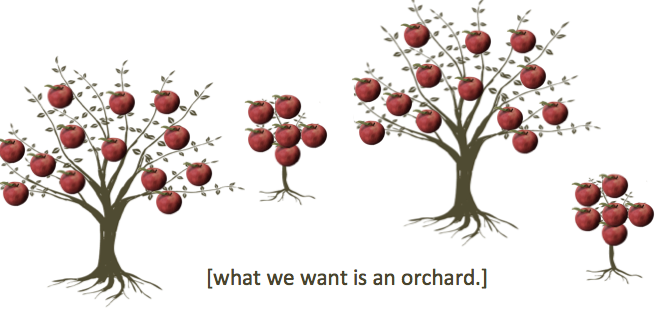
It feels that at some point, we might have lost our way. Perhaps we became more concerned with success than fruitfulness. Jesus says we evaluate things in the Kingdom on their fruitfulness…but somewhere along the way it became about the size of your tree. Now having a big tree is a fine thing. Just know you’re only successful in evaluating yourself against the size of other trees, and God has never been terribly concerned about tree size. Just fruitfulness. That’s it. The point of a tree isn’t how big your tree is but how much fruit you have. It’s about fruit! And in the Kingdom, fruitfulness is always about reproduction. (Specifically, reproducing disciples…multiplying Jesus’ life into the life of others who can then go and do the same.) Screen Shot 2013-03-03 at 8.53.46 AM
My experience tells me having a big tree doesn’t mean you have a lot of fruit. In fact, what I’ve seen happen a lot more often is people going after the big tree and hoping to get fruit, rather than going after fruit and knowing you get the tree along the way.
Choose the best, and you always get the good. Choose the good, you very rarely get the best.
Are we trying to start or lead churches, create Kingdom movements and aspire to all the breakthrough Jesus saw apart from the way Jesus did those things? Am I trying to make Jesus like me or do I honestly believe he was the best in the Kingdom business?
The Reformation was a significant moment because among other things, it put the Bible back in the hands of the people. But when we look at the church of the last 100 years, I have to wonder if we have been more influenced by the Enlightenment than the Reformation.
This is the gut check questionIf you had to choose between being known as a movement leader but not really having one, or actually being a movement leader but no one knowing it…which would you choose?
Tree or fruit?
Here’s the good news: I believe we are on the cusp of a new Reformation, one that sees the kind of fruit we saw from Jesus’ ministry, because we, once again, embrace not simply what Jesus did on the cross but the way he led and made disciples. Yes. I think we are on the tipping point of a new Reformation and it is about putting discipleship and mission back into the hands of ordinary people. Because when we equip the people of Jesus with the patterns, practices and way of Jesus, it will once again be ordinary people equipped to do extraordinary things.
The key is to embrace the mission of Jesus AND the way of Jesus. He’s just the best there ever was!
Hopefully you hear what I’m trying to convey clearly. I’m not suggesting we should go after a new Reformation. I’m suggesting it’s already happening. And maybe we don’t see it on every street corner yet, but I see it happening all around. A small group of communities, ready to be bloodied in going through the wall first, who are getting the beachhead of breakthrough for the rest of the church.
It’s already happening!
Screen Shot 2013-03-03 at 8.54.14 AMAt the end of the day, I don’t want a big tree. But I don’t want a small tree either. I want an orchard. I want a Kingdom movement where reproduction of Jesus’ life within individuals and communities is happening on every level. I’ve seen this happen before. I know it because I’ve seen it. And I think we are starting to see glimmers of this reality again. Lord, may it be so! May we see a Kingdom movement wash upon these shores.

If these longings resonate with you, here are three things you can do to step more fully into this groundswell:
  1. breen_bookSlideREPOST. Repost this link on twitter, facebook or your blog.
  2. RESPOND. Leave a comment on this post. Here’s the question: Where are the places you are seeing breakthrough in putting discipleship and mission back into the hands of ordinary people? We’d love to hear about it!
  3. READ. We just released a new book on this subject called Leading Kingdom Movements: the “Everyman” notebook on how to change the worldYou can pick up the ebook by clicking here. We think you’ll love it. Write a review. Read it and pass it on to a friend. The thing we are most concerned about is getting this idea out!

ARE WE ON THE BRINK OF A NEW REFORMATION? Part II


ARE WE ON THE BRINK OF A NEW REFORMATION? – MIKE BREEN


Last week I put up a post that discussed whether we are on the brink of a new Reformation. You can read that first post in its’ entirety here.
In summation, I believe that we are heading to that place in as much as the first Reformation had the wonderful effect of putting the Bible back into the hands of the people, the one we seem to be moving towards now is putting discipleship and mission back into the hands of ordinary people.
My suggestion was that when we focus more on the fruit that is produced (multiplying disciples who can do the same), the Kingdom always advances. If you’ve got a big tree (the church)…great…but it doesn’t matter too much if it’s not producing fruit.
Today, I want to look more at that idea of fruitfulness and why we should put all ofour time, attention and energy into it. I think today’s discussion will give us an even deeper look as to why we are on the precipice of something.
To do so, here is an excerpt from my book Leading Kingdom Movements.
++++++++++++++++++
Jesus gave us a picture of a tree and said that good trees are supposed to bear good fruit. It’s a simple picture, really. One tree can give you quite a lot of fruit. But it’s more. In each piece of fruit is the seed of multiplication. Each piece of fruit has dozens of seeds that could produce more trees. And there wasn’t just one piece of fruit on each tree, but lots of fruit.
So let’s run this out:
  • One tree
  • One tree, hypothetically, has 100 pieces of fruit
  • Each piece of fruit has, hypothetically, 20 seeds in it that can multiply into 20 more trees
  • One tree = 2,000 potential trees
Multiplication is what Jesus is talking about in the Parable of the Sower. In another, you expect a return of 30, 60, 100 times what you invest with the one seed. It’s multiplication.
Let’s understand the context of what Jesus was going after. When Jesus talked about trees and fruit, he was referring to something very specific: people. He was saying that each person is a tree, and a disciple is someone who produces good fruit. If we take Jesus’ metaphor seriously, he seems to be suggesting that a disciple will produce thousands of disciples.
If you’re at all like me, that can seem incredibly daunting.
Then you realize where we started and do the simple math. You can’t get there by addition, but you can by multiplication. We take what we’ve been given, invest it, and let it multiply.
Multiplication has been the way of the church for thousands of years because it was the way of Jesus.
The early church had two things going for it:
  1. They had the Holy Spirit.
  2. They knew how to multiply missional leaders.
That was it. No budgets, buildings, or any real cash on hand. All around there was moral relativism, polytheism, hedonism run amok, persecution, and an Empire that seemed to hate the church with a growing intensity.
And they blew the roof off!
At the end of the day, you could launch a missional movement with those same two things—the Holy Spirit and a way to multiply missional leaders. The problem is that many of us don’t actually believe that.
If you were to go to Sheffield (which is now the epicenter of a worldwide missional and discipling movement), they would not tell you how many people attend the church. I doubt most of the people would even realize how big the church is, because it doesn’t function like a huge one.
If you asked how big the church is, they would simply tell you how many people they are discipling. That is what they count. They count how many people are engaged in active, accountable, discipling relationships. Their whole structure for church is built around making disciples and releasing them. So that’s what they count. That’s the metric that matters. That’s the Great Commission imperative.
How many disciples do we have?
St. Thomas Sheffield isn’t a massive church and the center of a movement because it has the best worship service, or the best digital experience, or the best preachers or teachers in the world. It’s because everything they do is about making disciples. They honestly believe that if you make disciples and release them to lead into their destiny, release them to be Agents of the Kingdom, everything will change.
If we are great at making the disciples, church growth will never be a problem, because being a disciple means you’re a missionary. It was never OK for us to be a large church and have very few missionary disciples. So we built something where that couldn’t happen. Making disciples was in the DNA from the very beginning, and it has carried through into the movement of which it is the heart.

Sunday, February 26, 2012

1 Corinthians 10:31


Work as Worship from keephopealive on GodTube.

James 2:1-13

It was a cold winter’s day that Sunday. The parking lot to the church was filling up quickly. I noticed as I got out of my car fellow church members were whispering among themselves as they walked in the church.
As I got closer I saw a man leaned up against the wall outside the church. He was almost laying down as if he was asleep. He had on a long trench coat that was almost in shreds and a hat topped his head, pulled down so you could not see his face. He wore shoes that looked 30 years old, too small for his feet, with holes all over them, his toes stuck out.
I assumed this man was homeless, and asleep, so I walked on by through the doors of the church.
We all fellowshipped for a few minutes, and someone brought up the man laying outside. People snickered and gossiped but no one bothered to ask him to come in, including me.
A few moments later church began. We all waited for the Preacher to take his place and to give us the Word, when the doors to the church opened.
In came the homeless man walking down the aisle with his head down.
People gasped and whispered and made faces.
He made his way down the aisle and up onto the pulpit where he took off his hat and coat. My heart sank.
There stood our preacher…he was the “homeless man.”
No one said a word.
The preacher took his Bible and laid it on his stand.
“Folks, I don’t think I have to tell you what I am preaching about today...