Showing posts with label Missional. Show all posts

Friday, September 12, 2014

Inmate Football


There was an unusual high school football game played in Grapevine, Texas . The game was between Grapevine   Faith Academy and the Gainesville   State School. Faith is a Christian school and Gainesville State School is located within a maximum security correction facility.
Gainesville State School has 14 players. They play every game on the  road. Their record was 0-8. They've only scored twice. Their 14 players  are teenagers who have been convicted of crimes ranging from drugs to assault to robbery. Most had families who had disowned them.  They wore  outdated, used shoulder pads and helmets. Faith Academy was 7-2. They  had 70 players, 11 coaches, and the latest equipment.
Chris Hogan, the head coach at Faith Academy , knew the Gainesville team  would have no fans and it would be no contest, so he thought, “What if half of our fans and half of our cheerleaders, for one night only,  cheered for the other team?”  He sent out an email to the faithful asking them to do just that. “Here’s the message I want you to send,”  Hogan wrote. “You’re just as valuable as any other person on the   planet.”
Some folks were confused and thought he was nuts. One player said,  “Coach, why are we doing this?” Hogan said, “Imagine you don’t have a home life, no one to love you, no one pulling for you. Imagine that everyone pretty much had given up on you. Now, imagine what it would  feel like and mean to you for hundreds of people to suddenly believe in you.”
The idea took root. On the night of the game, imagine the surprise of  those 14 players when they took the field and there was a banner the  cheerleaders had made for them to crash through. The visitors’ stands were full. The cheerleaders were leading cheers for them. The fans were  calling them by their names. Isaiah, the quarterback-middle linebacker said, “I never in my life thought I would hear parents cheering to  tackle and hit their kid. Most of the time, when we come out, people are  afraid of us. You can see it in their eyes, but these people are yelling  for us. They knew our names.”
Faith won the game, and after the game the teams gathered at the 50-yard  line to pray. That’s when Isaiah, the teenage convict-quarterback surprised everybody and asked if he could pray.   he prayed, “Lord, I  don’t know what just happened so I don’t know how or who to say thank  you to, but I never knew there were so many people in the world who cared about us.”  On the way back to the bus, under guard, each one of  the players was handed a burger, fries, a coke, candy, a Bible, and an  encouraging letter from the players from Faith Academy .

Friday, April 5, 2013

Evangelistic Opportunities In Disguise (or How I Almost Put Apple Out Of Business)


Evangelistic Opportunities In Disguise (or How I Almost Put Apple Out Of Business)


apple genius barI’ve been having laptop problems all week.
I was told by my worship pastor that my new MAC laptop would be 100,000,000 times better than my PC because it would “Never have problems.”
MAC’s, I was told, could withstand every attack the dark side could proffer:
  • Cat videos on YouTube
  • Country music in iTunes
  • My mom’s 6,234 email forwards (“This is funny…read this…”)
Alas, I was sold a bill of goods. My MAC crashed this week. Twice.
To say I was ticked, frustrated, etc., is an understatement. So off I headed off in a fit of rage to my local Apple store to get it fixed.
Once in line I began rehearsing my 5 point speech for the manager:
  1. Hey idiot, I went from PC to MAC to prevent these problems.
  2. Snarky comment about how “All these un-showered hipsters standing around in blue shirts doing nothing remind me of a state highway construction crew.”
  3. I read Steve Jobs’ insufferable 1,934 page biography, which should count for something, ANYTHING.
  4. Demand a replacement for the lemon I was given.
  5. End with a threat – I have 3014 Twitter followers, and JUST ONE TWEET to my coalition of 3 pastors and 3011 online get-rich-quick experts posing as real people, and we’ll bring your stupid company to a grinding halt!
I was ready for ‘em.
But, to his loss, Sean, the manager, never heard my riveting speech.
I was only able to get out the words, “I’m having problems,” before he grabbed two techs who patiently worked on my laptop for over an hour, ultimately fixing my problem.
No, I never got to express my pent-up frustration.
But I did get to talk to one of the techs about what’s going on in his life for over an hour, how God fits into that, and then invite him to visit CCV this weekend.
Which, I realized later, was probably the reason my laptop malfunctioned in the first place.
And which, when you think about it, is probably a good explanation for why we go through most of the lousy things we experience in life.
It’s probably a good practice to remind ourselves that for every computer problem in our life there’s a tech somewhere that needs to hear the gospel.
Ever noticed that in your life?

Wednesday, March 20, 2013

ARE WE ON THE BRINK OF A NEW REFORMATION? Part I


If you could have a big tree with only a little fruit or a small tree with lots of fruit, which would you choose? It’s about a choice, right?
But we’ll get back to that in a second.
I’ve noticed there seem to be two things I can do with Jesus. Either I can increasingly look like Jesus, or I can make him look like me.
I can look like Jesus or I can try to make him look like me.
The funny thing about Jesus is that I’m never sure we give him quite enough credit. Sure. He came to earth, left the throne of heaven, took on the nature of a servant and died on the cross in our place, rose from the dead and now sits at the right hand of the Father. Yes. All that happened.
But we really don’t give his three years of ministry much reference.
Here’s what I mean: We think Jesus was the Son of God, but when we read the Gospels, do you think he was the smartest person who ever lived? Most accomplished? Best fisherman? Best evangelist? Best church planter? Best movement leader? Best discipler? Most successful leader?
For instance, in Luke 9 and again in Luke 10, Jesus gave the most detailed strategy you will ever find in the scriptures for how to evangelize, and then we see the exact same strategy used in the early church. Shouldn’t we be using that same strategy? I’m guessing we’re not arrogant enough to think we’ve come up with a better strategy than Jesus. (Example: for most churches, the evangelism strategy is “invite your friends to church and then let the professionals take over. We’ll do the heavy lifting if you get them here.” Not exactly Jesus’ strategy!)
We acknowledge what Jesus did on the cross, but what about what was started before the cross? What about the movement he began that changed the course of human history when it was released and catalyzed after the Resurrection and Pentecost? If being a disciple is “who Jesus would be if he were me” (Dallas Willard), shouldn’t we be learning the patterns and practices of the best whom ever lived if we too want to change the world for the Kingdom?
Yet often when we look at the Western church, I’m not sure we see many of the practices of Jesus among the way we lead. Though…that’s starting to change!
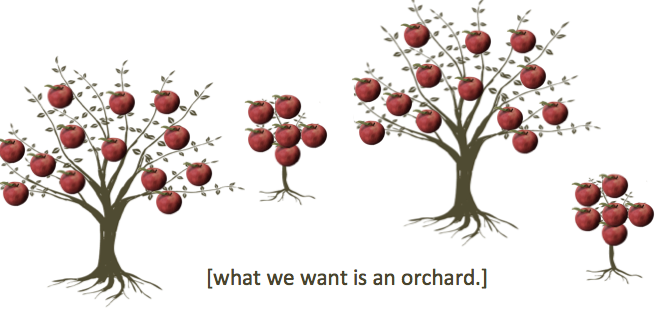
Back to the original question: Big tree/little fruit or little tree/lots of fruit?
It feels that at some point, we might have lost our way. Perhaps we became more concerned with success than fruitfulness. Jesus says we evaluate things in the Kingdom on their fruitfulness…but somewhere along the way it became about the size of your tree. Now having a big tree is a fine thing. Just know you’re only successful in evaluating yourself against the size of other trees, and God has never been terribly concerned about tree size. Just fruitfulness. That’s it. The point of a tree isn’t how big your tree is but how much fruit you have. It’s about fruit! And in the Kingdom, fruitfulness is always about reproduction. (Specifically, reproducing disciples…multiplying Jesus’ life into the life of others who can then go and do the same.) Screen Shot 2013-03-03 at 8.53.46 AM
My experience tells me having a big tree doesn’t mean you have a lot of fruit. In fact, what I’ve seen happen a lot more often is people going after the big tree and hoping to get fruit, rather than going after fruit and knowing you get the tree along the way.
Choose the best, and you always get the good. Choose the good, you very rarely get the best.
Are we trying to start or lead churches, create Kingdom movements and aspire to all the breakthrough Jesus saw apart from the way Jesus did those things? Am I trying to make Jesus like me or do I honestly believe he was the best in the Kingdom business?
The Reformation was a significant moment because among other things, it put the Bible back in the hands of the people. But when we look at the church of the last 100 years, I have to wonder if we have been more influenced by the Enlightenment than the Reformation.
This is the gut check questionIf you had to choose between being known as a movement leader but not really having one, or actually being a movement leader but no one knowing it…which would you choose?
Tree or fruit?
Here’s the good news: I believe we are on the cusp of a new Reformation, one that sees the kind of fruit we saw from Jesus’ ministry, because we, once again, embrace not simply what Jesus did on the cross but the way he led and made disciples. Yes. I think we are on the tipping point of a new Reformation and it is about putting discipleship and mission back into the hands of ordinary people. Because when we equip the people of Jesus with the patterns, practices and way of Jesus, it will once again be ordinary people equipped to do extraordinary things.
The key is to embrace the mission of Jesus AND the way of Jesus. He’s just the best there ever was!
Hopefully you hear what I’m trying to convey clearly. I’m not suggesting we should go after a new Reformation. I’m suggesting it’s already happening. And maybe we don’t see it on every street corner yet, but I see it happening all around. A small group of communities, ready to be bloodied in going through the wall first, who are getting the beachhead of breakthrough for the rest of the church.
It’s already happening!
Screen Shot 2013-03-03 at 8.54.14 AMAt the end of the day, I don’t want a big tree. But I don’t want a small tree either. I want an orchard. I want a Kingdom movement where reproduction of Jesus’ life within individuals and communities is happening on every level. I’ve seen this happen before. I know it because I’ve seen it. And I think we are starting to see glimmers of this reality again. Lord, may it be so! May we see a Kingdom movement wash upon these shores.

If these longings resonate with you, here are three things you can do to step more fully into this groundswell:
  1. breen_bookSlideREPOST. Repost this link on twitter, facebook or your blog.
  2. RESPOND. Leave a comment on this post. Here’s the question: Where are the places you are seeing breakthrough in putting discipleship and mission back into the hands of ordinary people? We’d love to hear about it!
  3. READ. We just released a new book on this subject called Leading Kingdom Movements: the “Everyman” notebook on how to change the worldYou can pick up the ebook by clicking here. We think you’ll love it. Write a review. Read it and pass it on to a friend. The thing we are most concerned about is getting this idea out!

ARE WE ON THE BRINK OF A NEW REFORMATION? Part II


ARE WE ON THE BRINK OF A NEW REFORMATION? – MIKE BREEN


Last week I put up a post that discussed whether we are on the brink of a new Reformation. You can read that first post in its’ entirety here.
In summation, I believe that we are heading to that place in as much as the first Reformation had the wonderful effect of putting the Bible back into the hands of the people, the one we seem to be moving towards now is putting discipleship and mission back into the hands of ordinary people.
My suggestion was that when we focus more on the fruit that is produced (multiplying disciples who can do the same), the Kingdom always advances. If you’ve got a big tree (the church)…great…but it doesn’t matter too much if it’s not producing fruit.
Today, I want to look more at that idea of fruitfulness and why we should put all ofour time, attention and energy into it. I think today’s discussion will give us an even deeper look as to why we are on the precipice of something.
To do so, here is an excerpt from my book Leading Kingdom Movements.
++++++++++++++++++
Jesus gave us a picture of a tree and said that good trees are supposed to bear good fruit. It’s a simple picture, really. One tree can give you quite a lot of fruit. But it’s more. In each piece of fruit is the seed of multiplication. Each piece of fruit has dozens of seeds that could produce more trees. And there wasn’t just one piece of fruit on each tree, but lots of fruit.
So let’s run this out:
  • One tree
  • One tree, hypothetically, has 100 pieces of fruit
  • Each piece of fruit has, hypothetically, 20 seeds in it that can multiply into 20 more trees
  • One tree = 2,000 potential trees
Multiplication is what Jesus is talking about in the Parable of the Sower. In another, you expect a return of 30, 60, 100 times what you invest with the one seed. It’s multiplication.
Let’s understand the context of what Jesus was going after. When Jesus talked about trees and fruit, he was referring to something very specific: people. He was saying that each person is a tree, and a disciple is someone who produces good fruit. If we take Jesus’ metaphor seriously, he seems to be suggesting that a disciple will produce thousands of disciples.
If you’re at all like me, that can seem incredibly daunting.
Then you realize where we started and do the simple math. You can’t get there by addition, but you can by multiplication. We take what we’ve been given, invest it, and let it multiply.
Multiplication has been the way of the church for thousands of years because it was the way of Jesus.
The early church had two things going for it:
  1. They had the Holy Spirit.
  2. They knew how to multiply missional leaders.
That was it. No budgets, buildings, or any real cash on hand. All around there was moral relativism, polytheism, hedonism run amok, persecution, and an Empire that seemed to hate the church with a growing intensity.
And they blew the roof off!
At the end of the day, you could launch a missional movement with those same two things—the Holy Spirit and a way to multiply missional leaders. The problem is that many of us don’t actually believe that.
If you were to go to Sheffield (which is now the epicenter of a worldwide missional and discipling movement), they would not tell you how many people attend the church. I doubt most of the people would even realize how big the church is, because it doesn’t function like a huge one.
If you asked how big the church is, they would simply tell you how many people they are discipling. That is what they count. They count how many people are engaged in active, accountable, discipling relationships. Their whole structure for church is built around making disciples and releasing them. So that’s what they count. That’s the metric that matters. That’s the Great Commission imperative.
How many disciples do we have?
St. Thomas Sheffield isn’t a massive church and the center of a movement because it has the best worship service, or the best digital experience, or the best preachers or teachers in the world. It’s because everything they do is about making disciples. They honestly believe that if you make disciples and release them to lead into their destiny, release them to be Agents of the Kingdom, everything will change.
If we are great at making the disciples, church growth will never be a problem, because being a disciple means you’re a missionary. It was never OK for us to be a large church and have very few missionary disciples. So we built something where that couldn’t happen. Making disciples was in the DNA from the very beginning, and it has carried through into the movement of which it is the heart.

8 ways to be missional in a small community context


8 ways to be missional in a small community context


Because many in the Bible belt have been raised in a Christian context, they feel that they are Christian though they may not know anything about the Gospel. As well, there are many who grew up going to church and in fact have experienced a saving relationship with God. However they are no longer attending church and have not for years.

Many of these people are living lives that are entrenched in deep overt sin. Others are living exceptionally moral lives. Each of these groups that are being lived out are done so, “far from God”. Additionally, since most who live in the Bible belt believe themselves to be Christian because the name of the state on their driver’s license is from the Bible belt, I am including them in the group “far from God”.

So the following  group that I will call “far from God” includes the following:

a     .       Those who are Christian in name only.
b     .      Believers who have strayed from the Gospel and are living immoral lives.
c     .       Believers who have strayed from the Gospel and are living morally upright lives.

Following are 8 ways to be missional in a small community context.

1.       Eat with Non-Christians and those who are “far from God”.
a.       Because we eat at least 3 meals a day, let’s begin to share these meals with others. Let’s include those who are far from God as well as those who freely admit that they are not Christian.
b.      This may include
                                                               i.      neighbors
                                                             ii.      friends from work
                                                            iii.      new people who have moved into town

2.       Be a regular.
a.       If your town is not too small, seek to do business with the same people every time you make a transaction. Just make sure that those who are the ones you are interacting with are far from God. Some examples might be:
                                                               i.      purchase your gas from the same gas station
                                                             ii.      go to the same pharmacy
                                                            iii.       eat at the same diners etc…
                                                           iv.      drink coffee with the coffee drinkers in the community

3.       Hobby with Non-Christians and those who are “far from God”.
a.       Fish
b.      Crochet
c.       Sew
d.      Yard work
e.      Gardening flower/vegetable
f.        Walking
g.       Writing
h.      Music
i.         Cooking
j.        Collecting

4.       Participate in community events.
a.       Parades
b.      Musical events
c.       Theater
d.      Dance
e.      Recitals
f.        Clean ups
g.       Festivals
h.      Fundraisers
i.         If the town is really small, participate in the events that occur within the local high school(s) and junior high(s).
                                                               i.      Basketball games
                                                             ii.      Volleyball games
                                                            iii.      Football
                                                           iv.      Track
                                                             v.      FCA projects
                                                           vi.      Academic contests
                                                          vii.      Teacher aids
                                                        viii.      Story reading

5.       Seek to step out of your comfort zone and talk to people. The best conversation takes place when we listen. As we listen we are able to formulate questions that helps direct the conversation. By doing so we learn about others. We learn their hopes, their passions, their desires, their dreams, their pain, loss they have experienced.
a.       Through listening we are able to better understand who these people are and why they say the things they say, do the things they do and are the people they are.
b.      We are also better equipped to pray for these people.
c.       We are better equipped to love them and show compassion.
d.      We learn what these people are not believing about the Gospel and are able to show them how they may have hope.

Those whom we may talk to are:
                                                               i.      Those who we do regular business with.
                                                             ii.      Co-Workers
                                                            iii.      Neighbors
                                                           iv.      Those whom we participate with in community events
                                                             v.      Strike up conversations with people you do not know.

6.       Volunteer with Non-Profits.
a.       Thrift stores
b.      Environment related organizations
c.       Animal related organizations
d.      Health services
e.      Human services
f.        International or foreign affairs

7.       Serve your neighbors.
a.       Yard work
b.      Painting
c.       Wash their car
d.      Baby sit
e.      Animal sit
f.        House watch

8.       Seek to be missional in all things. Or another way of saying that is seek to be a blessing. Whether we help paint another’s home, volunteer at the local thrift store or eat with those who are far from God, we are to do it all for His glory. Do not add these things to our lives as “to do” lists but as the way of life; a life that is joyously lived out serving others out of the overflow of our love for our Creator.

a.       In all things seek to be a blessing to others. Be creative in ways that you might be a blessing.
b.      Even more, listen to the Spirit’s prompting and obey. We have been commanded to be a blessing and if we are seeking to do so, God will bring people across our paths who we are to bless. Listen to His prompting and obey and step back to see what God does through our blessing both to the person whom we have blessed as well as to ourselves.

by Michael J. Lee

4 Things You Should Know About Your Community


4 Things You Should Know About Your Community


Often when I ask another pastor who his church is trying to reach, he gives me a very spiritual answer—lost people. It sounds good, but it usually means the pastor has a very fuzzy view of his own community.
When I was in seminary, I was taught I had to understand the culture of the New Testament before I could understand the message of the New Testament. If I understood the culture that the New Testament was set against, I could extract the timeless truth from the text. Every biblical preacher does that when he preaches a sermon.
But I was never taught to exegete the community where I serve. That’s what targeting is. I should know the geography, customs, culture and religious background of my community as much as I do about the biblical times.
You can’t faithfully communicate God’s Word until you exegete your text and your community.
So what about your community should you know? I’d start with these four areas.
  • Its geography. Simply define where the people you want to reach live. Get a map of your city or area and mark where your church is located on that map. Estimate a 15 to 20 minute drive (reasonable driving distance may be a bit different in your community) in each direction from your church and mark those as borders of your primary ministry area. This is your “evangelistic fishing pond.” You may have people drive a couple of hours to get to your church. But most of the people who’ll attend your church will live nearby. By the way, your “fishing pond” will likely expand as your church grows.
  • Its demography. You need to know who lives in the area you’re targeting. Not all demographics will be helpful. I’d focus on a breakdown of these stats: age, marital status, income and occupation. Other stats are interesting but won’t make a difference in what you do in your church. Don’t overdue demographic research.
  • Its culture. No missionary in foreign lands would try to evangelize without understanding the culture. You shouldn’t either. You can’t learn it from studying census data either. Looking for the values, interests, hurts and fears of people means you have to talk to people in your community!
  • Its spirituality. Try to determine what the people in your community understand about the Gospel. Other pastors are often the best source for this. When I started Saddleback, I wrote a letter to all of the evangelical pastors in the Saddleback Valley and asked them some basic information about the spiritual background of the community. I got some great insights from that!